 Noboribetsu Bear Park
Things to Do in Noboribetsu: Every Stop, Timed and Mapped
Most lists of things to do in Noboribetsu run to five items and stop at the crater. This one runs to nineteen, each with the walk from the bus terminal, the time it needs, whether the season closes it and which of the tour listings compared here actually stops there. The pattern that falls out is the useful part: nine of these are free and within a ten-minute walk of one bus stop, nine are reached by no tour at all, and the four biggest tour clusters are an hour west at Lake Toya rather than in Noboribetsu. Coordinates were verified against OpenStreetMap in August 2026, and the whole set is plotted on the interactive map. Bookable options sit on the Noboribetsu Bear Park ticket and tour comparison.
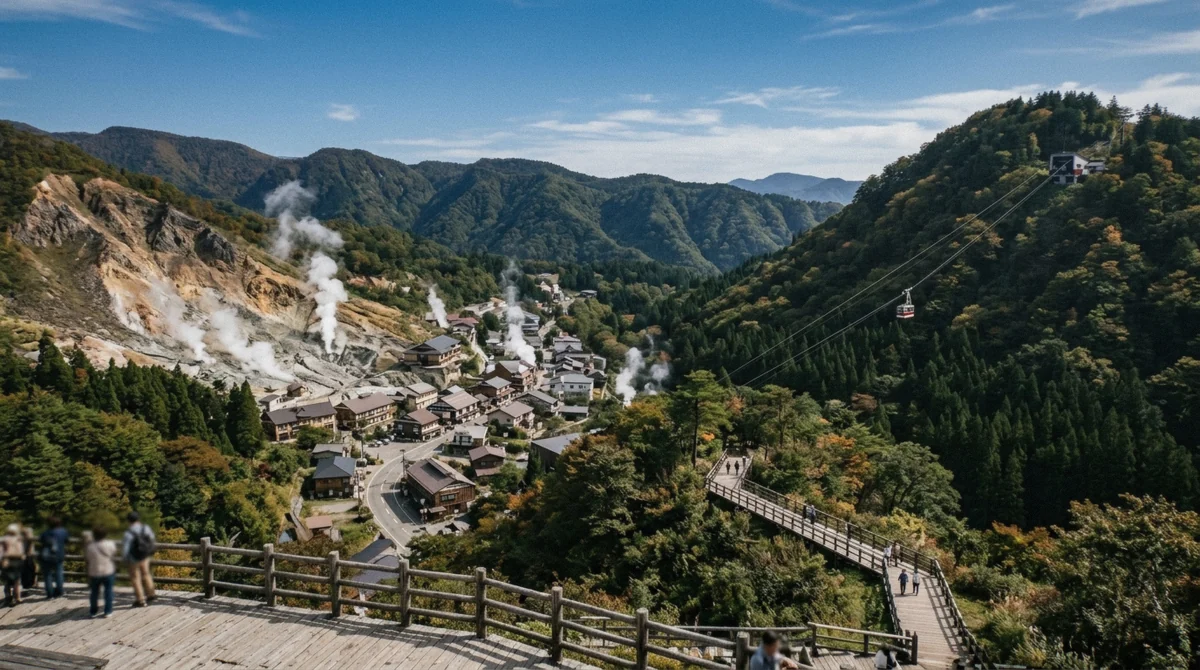
Quick answer The short list, and the free things nobody sells you
If you have half a day: the bear park by gondola, then Jigokudani on foot. If you have a full day, carry on past the crater to the Oyunuma boiling pond and sit in the free natural foot bath in the river below it, which is the single most recommended thing in Noboribetsu and costs nothing. Add the geyser in Sengen Park and the mechanical King Enma on Gokuraku-dori and you have a day without a vehicle or a ticket beyond ¥3,200 (about $22). Everything at Lake Toya, an hour west, needs a coach or a car, and everything the coaches do stop at is on the map.
Key takeaways
- 19 stops, coordinates verified against OpenStreetMap, August 2026
- 9 are walkable from the Noboribetsu Onsen bus terminal
- 9 are reached by no tour in the catalogue
- The only paid stop in the town is the ¥3,200 bear park ticket
- Jigokudani, the foot bath, the geyser and Enma-do are all free
Every Stop at a Glance
Walking times are from the Noboribetsu Onsen bus terminal. The winter column matters because two of the nineteen close and several become harder underfoot.
The full inventory
Sorted by how far you have to go. Everything above Date Jidaimura is on foot or a gondola.
| Stop | What it is | Time needed | From the terminal | Open in winter |
|---|---|---|---|---|
| Gokuraku-dori | Ogre-lined main street | 20 min | On it | Yes |
| Enma-do | Mechanical King Enma hall | 10 min | 4 min walk | Yes |
| Sengen Park | Street-side geyser | 10 min | 5 min walk | Yes |
| Ropeway base station | The only way up the mountain | 10 min | 2 min walk | Shorter hours |
| Noboribetsu Bear Park | 70 brown bears, museum, Ainu village | 90 min | 9 min by gondola | Closes some Feb weekdays |
| Lake Kuttara | Caldera lake viewpoint | 15 min | From the park summit | With the park |
| Jigokudani | Steaming explosion crater | 20 min | 15 min walk | Yes |
| Oyunuma | Boiling sulphur pond | 15 min | 35 min walk | Yes, best in snow |
| Hiyoriyama | Active vent above the pond | 10 min | 40 min walk | Trail slippery |
| Oyunuma-gawa foot bath | Free natural hot river | 20 min | 40 min walk | Yes |
| Date Jidaimura | Edo-period theme village | 2 to 2.5 h | 10 min by car | Yes |
| JR Noboribetsu Station | Rail connection to Sapporo | Transit | 15 to 20 min by bus | Yes |
| Marine Park Nixe | Aquarium in a replica castle | 2 h | 25 min by bus and foot | Yes |
| Cape Chikyu | 100 m Pacific cliffs | 30 min | 45 min by car | Yes, very exposed |
| Showa Shinzan | 1943 lava dome, still steaming | 30 min | 1 h west by car | Yes |
| Showa Shinzan Bear Ranch | The other bear facility, about ¥1,000 | 45 min | 1 h west | Yes |
| Mount Usu Ropeway | Cable car to an active crater rim | 80 min | 1 h west | Suspends in wind |
| Lake Toya | Non-freezing caldera lake | 1 to 2 h | 1 h 15 west | Yes |
How Much Time Do You Have?
Four plans, each built from the stops above rather than from a brochure.
Three hours
The gondola and the crater, in that order. Ride up for the bear park, give it ninety minutes including the feeding decks and the Kuttara viewpoint, come down and walk fifteen minutes to Jigokudani for the boardwalk loop. That is the shape of a cruise-passenger or a rushed day-tripper's visit, and it covers what most people picture when they think of Noboribetsu.
Cost: ¥3,200 (about $22) and nothing else.
Half a day
Add the walk. Past Jigokudani the trail climbs twenty minutes through forest to the Oyunuma boiling pond, then drops to the Oyunuma-gawa where the runoff cools into a river you can sit in. Bring a small towel.
Back through town, stop at the Sengen Park geyser and the Enma-do hall on Gokuraku-dori, both free and both two minutes off your route. Five hours, one ticket.
A full day
Everything above, unhurried, plus either Date Jidaimura for two and a half hours of Edo-period theatre or, with children, the Marine Park Nixe aquarium down by the station. Both need transport: Jidaimura is ten minutes by taxi, Nixe is the ¥450 bus to JR Noboribetsu Station and a five-minute walk. Or trade both for a slow evening in the baths, which is what staying overnight buys you.
A second visit, or a car
Go west. Cape Chikyu's cliffs are forty-five minutes away and almost nothing on the Lake Toya coach circuit is closer than an hour: Showa Shinzan, the bear ranch at its foot, the Usuzan Ropeway to a live crater rim and the lake itself. That is a full second day, and it is the day the Sapporo coaches sell. The comparison table shows which listing covers which of them.
In the Onsen Town, on Foot
Five stops inside a ten-minute radius of the bus terminal, four of them free.
Gokuraku-dori and the ogre statues
Walk Runs from the bus terminal · Time 20 minutes · Season Open all year · On a tour Samurai village private day
The main street runs uphill from the bus terminal and is lined with painted ogre statues that lean hard into the valley's hell theme, alongside souvenir shops and ramen counters. It is where the August ogre festival happens and where most visitors eat. The single thing that decides how you experience it: after four in the afternoon the day-trip coaches have gone and it becomes a quiet hot-spring street rather than a queue.
Enma-do and the judgement of the dead
Walk On Gokuraku-dori · Time 10 minutes · Season Open all year · On a tour No listed tour stops here
A small hall partway up Gokuraku-dori housing a mechanical King Enma, the Buddhist judge of the dead, whose face shifts from calm to furious several times a day as he passes sentence. It takes ninety seconds and it is free, and it is the clearest expression of the joke the town has been making about itself for a century. Check the posted times so you arrive for a judgement rather than an idle statue.
The Sengen Park geyser
Walk 5 min from the bus terminal · Time 10 minutes · Season Open all year · On a tour No listed tour stops here
A small park set back from the pavement where a geyser vents steam and hot water on a roughly three-hourly cycle. There is no ticket, no gate and very little signage in English, which is why most day-trippers walk straight past it on the way to the ropeway. Time your walk back down from Jigokudani to coincide and you get the best free spectacle in the town.
The ropeway base station
Walk 2 min from the bus terminal · Time 10 minutes · Season Tickets from 9:00, or 9:30 in winter · On a tour Admission ticket · Private bear park day
The only visitor route to the mountain, two minutes from the bus terminal, and the point at which the ¥3,200 (about $22) changes hands. The detail that catches people out is physical rather than financial: twenty steps sit before the ticket gate, and while free wheelchairs are kept here, riders must transfer to a park chair for the gondola and be accompanied. Ticket sales stop 40 minutes before the park closes.
The bus terminal itself
Walk The arrival point · Time Transit · Season Open all year · On a tour No listed tour stops here
Worth naming because it is the hinge of every plan on this page. The direct highway coach from Sapporo arrives here in about one hour fifty for ¥2,500 to ¥2,800 (roughly $17 to $19), and the Donan Bus from JR Noboribetsu Station arrives here in fifteen to twenty minutes for ¥450 (about $3). Everything in this section is a walk from the door. Full route detail here.
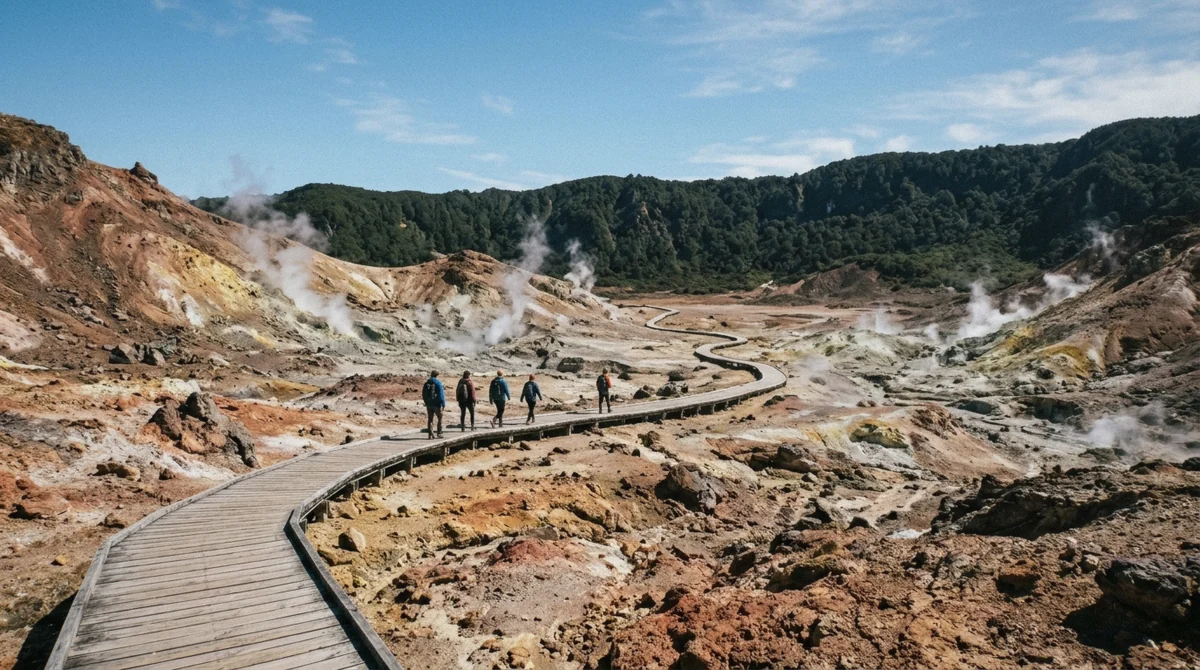
The Volcanic Walk
Four stops on one free trail, and the reason forty minutes at the crater is not enough.
Jigokudani (Hell Valley)
Walk 15 min uphill from the bus terminal · Time 20 minutes on the boardwalk · Season Open all year; lit on summer evenings · On a tour 9 of the listings compared here
A 450-metre explosion crater left by the eruption of Mount Hiyori, floored in rust and sulphur-yellow rock, with fumaroles venting and hot springs bubbling across it. A raised boardwalk runs out to a viewing platform and takes twenty unhurried minutes. The thing that decides your visit is the wind: on a cold still morning the steam thickens enough to close visibility on the walkway for a minute at a time, which is either the best photograph of your trip or a wasted stop.
Oyunuma
Walk 20 min on the forest trail beyond Jigokudani · Time 15 minutes · Season Open all year; best against winter snow · On a tour Private bear park day
A boiling, sulphur-yellow pond that steams year-round, around 50°C at the surface and considerably hotter beneath. The trail from Jigokudani climbs through forest for twenty minutes to reach it and there is a viewing area rather than any access to the water. In winter the steam against snow-loaded pines is the image the whole valley is known for, and it is the one stop no group coach has time to include.
Hiyoriyama
Walk On the trail above Oyunuma · Time 10 minutes · Season Open all year; trail slippery under snow · On a tour No listed tour stops here
The small active cone above Oyunuma whose eruption blew out the crater you have just walked across. It vents visibly and marks the high point of the route. Nothing here is a formal attraction, which is exactly the appeal: after the boardwalk crowds it is usually empty. The trail is the deciding factor, since it is genuinely slippery under snow and unlit after dark.
The Oyunuma-gawa natural foot bath
Walk 5 min downstream of Oyunuma · Time 20 minutes · Season Open all year · On a tour No listed tour stops here
Downstream of the pond the runoff cools into a river at a temperature you can put your feet into, with benches set along the bank in the forest. It is free, unstaffed and open whenever you can walk to it, and it is the most consistently recommended thing in Noboribetsu among independent visitors. Bring a small towel, because nothing is provided, and come after the walk rather than before it.
Up the Ropeway
Two stops, one ticket, and the only part of this page that costs money in the town.
Noboribetsu Bear Park
Walk 7 min by gondola from the town · Time 90 minutes · Season Closed for the spring ropeway inspection and on scattered February weekdays · On a tour Admission ticket · Private bear park day
Around seventy Ezo brown bears on a 550-metre summit, watched from raised decks and fed with packets bought inside at ¥200 to ¥500 (roughly $1.50 to $3.50). Alongside them: the Brown Bear Museum, the Yukar Village Ainu kotan and the Lake Kuttara Observatory, all inside the same fare as the gondola. The deciding factor is weather rather than crowds, since cloud removes the viewpoint entirely and that is a quarter of what the ticket buys. Whether it is worth it is covered here.
Lake Kuttara
Walk Viewed from the bear park summit · Time 15 minutes at the viewpoint · Season Viewpoint closed when the park is · On a tour Admission ticket · Private bear park day
A near-perfectly circular caldera lake east of the park, with water clarity measured in the tens of metres and one visitor report putting transparency at around twenty. From the observatory at the summit it reads as an almost drawn circle of deep blue in the forest. The shore itself is a separate drive with no public transport, so for practical purposes the viewpoint is the visit, and free Wi-Fi reaches all the way out to the deck.
Coast, Valley and Lake Toya
Everything that needs a vehicle, in order of distance.
Noboribetsu Date Jidaimura
Walk 10 min by car from the onsen town · Time 2 to 2.5 hours · Season Open all year · On a tour Private bear park day · Samurai village private day
A recreated Edo-period village with samurai streets, ninja shows and costumed performers, ten minutes by car from the onsen town and awkward to reach without one. It is a theme park rather than a preserved site and works best with children over about six. Two of the listings include it, and one of those has its admission inside the fare, which matters because it is among the pricier attractions in the area.
Noboribetsu Marine Park Nixe
Walk 5 min from JR Noboribetsu Station · Time 2 hours · Season Open all year · On a tour No listed tour stops here
An aquarium built inside a replica Danish castle, five minutes on foot from JR Noboribetsu Station down in the valley. No tour in the catalogue stops here, which makes it the local alternative rather than a headline: it is where families go when the weather closes the mountain, and it is reachable on the same ¥450 bus you would use for the train.
Cape Chikyu
Walk About 45 min by car · Time 30 minutes · Season Open all year; bring a windbreaker · On a tour Bus tour · All fees included · Samurai village day
A hundred metres of cliff at the end of the Muroran peninsula, with a white lighthouse and, on a clear day, a horizon that visibly curves; the name means Earth Cape. Three listings stop here and all of them allow under half an hour. The deciding factor is exposure rather than time, since the operators list a windbreaker as year-round kit rather than a winter item.
Showa Shinzan and its bear ranch
Walk About 1 h by car west · Time 30 minutes · Season Open all year · On a tour Most booked · Bus tour
A lava dome that pushed itself out of a wheat field in 1943 and still steams. At its foot sits Showa Shinzan Bear Ranch, around ¥1,000 (about $7), and this is the bear stop four of the listings compared here actually visit. It is a separate business from the park above Noboribetsu Onsen and an hour to the west, which is the single most useful thing to know before booking a Sapporo coach.
Mount Usu Ropeway and Lake Toya
Walk At the Showa Shinzan car park · Time 80 minutes · Season Suspends in high wind · On a tour Most booked · Bus tour · All fees included · Jozankei route
The cable car crosses to a viewing platform on the rim of Usu, an active volcano that erupted as recently as 2000, looking down on Lake Toya on one side and the lava dome on the other. About ¥2,000 (roughly $14) unless your fare includes it. Below sits the lake itself, Japan's northernmost that never freezes, where seven of the listings spend their afternoon between the lakeshore, Lake Hill Farm and the silo observation deck.
Best Time of Day for Each Stop
The valley rewards an early start more than most destinations, because the coaches all arrive within the same hour.
When to be where
Coaches from Sapporo reach Jigokudani around 09:50 and leave the valley by early afternoon, which shapes everything below.
| Stop | Best time | Why |
|---|---|---|
| Noboribetsu Bear Park | First gondola, 9:00 or 9:30 | Keeper events run early and the Kuttara view is clearest |
| Jigokudani | Before 09:30 or after 16:00 | The coach window sits between those two |
| Oyunuma | Cold still mornings | Steam density peaks when the air is coldest |
| Oyunuma-gawa foot bath | Late afternoon | After the walk, and the light through the forest is best |
| Sengen Park geyser | Check the posted cycle | It vents roughly every three hours |
| Enma-do | Posted judgement times | The mechanism only runs a few times a day |
| Gokuraku-dori | After 16:00 | The day-trip crowd has gone and the lanterns come on |
| Cape Chikyu | Midday, clear weather | The curved horizon needs visibility, not soft light |
| Lake Toya | Early afternoon | Which is when every coach itinerary schedules it |
What Winter Removes, and What It Adds
Two of the nineteen close and several change character. None of it is a reason to stay away.
What closes
Only the mountain. The bear park shuts on scattered weekdays through February and for several weeks each spring while the ropeway undergoes its scheduled inspection, and the Lake Kuttara viewpoint goes with it since it is inside the park. The Usuzan Ropeway an hour west suspends in high wind.
Everything else on this page, including the entire free walking route, stays open. The closure patterns are set out here.
What gets better
Oyunuma. Steam against snow-loaded pines is the best thing in Noboribetsu and it only exists between December and March. Jigokudani gains the same contrast, the ogre statues on Gokuraku-dori wear snow caps, and the town empties.
The bears stay in their outdoor enclosures throughout, so a January visit loses nothing on that front.
What to plan for
Shorter hours and harder walking. The park runs 9:30 to 16:30 with a last ticket at 15:50, and the operator warns directly that heavy snow makes its paths difficult and can rule out wheelchair use. The forest trail past Oyunuma needs boots with grip.
Daylight goes early, which is a real argument for a night in the onsen town rather than a ten-hour coach day out of Sapporo.
Which Tour Reaches Which Stop
The catalogue, read as coverage rather than as prices. Nine of the nineteen stops appear in no itinerary at all.
Coverage by listing
Read down the Noboribetsu Bear Park column and the market becomes clear at a glance.
| Listing | Bear Park | Jigokudani | Lake Toya cluster | Other stops |
|---|---|---|---|---|
| Admission ticket | Yes | No | No | Lake Kuttara viewpoint |
| Private bear park day | Yes, entry extra | Yes | No | Oyunuma, Date Jidaimura |
| Most booked coach | No | Yes | Yes | Bear ranch, Usuzan Ropeway |
| Daily bus tour | No | Yes | Yes | Cape Chikyu, Usuzan Ropeway |
| Niseko route | No | Yes | Yes | Mount Yotei, Takahashi Farm |
| All fees included | No | Yes | Yes | Cape Chikyu, bear ranch, Fukidashi |
| Lowest fare | No | Yes | Yes | Bear ranch |
| Jozankei route | No | Yes | Yes | Bear ranch or ropeway, Jozankei |
| Hotel pickup | No | Yes | Yes | Showa Shinzan area |
| Samurai village day | No | Yes | No | Cape Chikyu, Date Jidaimura |
The nine nobody stops at
The Oyunuma-gawa foot bath, the Hiyoriyama vent, the Sengen Park geyser, Enma-do, the bus terminal, the shore of Lake Kuttara, Marine Park Nixe and JR Noboribetsu Station appear in no itinerary in the catalogue. Several are among the best free things in the valley. That is not a research gap, it is what a ten-hour coach day has room for, and it is the argument for building your own day from the map instead.
Noboribetsu Questions
What is Noboribetsu famous for?
Hot springs and a steaming volcanic crater. The town draws several distinct spring types in unusual volume, and Jigokudani, the explosion crater above it, is the source. The bear park on the mountain and the Edo-period village down the valley are the other two things most visitors come for.
How long should I spend in Noboribetsu?
Three hours covers the bear park and the crater boardwalk. Half a day adds the walk to Oyunuma and the free foot bath, which is the version independent visitors rate highest. A full day or an overnight lets you add Date Jidaimura or the baths without rushing.
What is there to do in Noboribetsu for free?
Jigokudani, Oyunuma, the Hiyoriyama vent, the Oyunuma-gawa natural foot bath, the Sengen Park geyser, Enma-do and the ogre statues along Gokuraku-dori. Seven stops, no tickets, all within a forty-minute walk of the bus terminal.
Is Noboribetsu worth visiting?
For a hot-spring town with a walkable volcanic crater attached, yes, and it is the single easiest onsen day out of Sapporo. The bear park is a separate question, and the honest answer there depends on whether you were hoping for captive bears or wild ones.
Can you do everything in one day?
Everything in the onsen town, comfortably. Adding Date Jidaimura or the Lake Toya cluster means either a car or a coach tour, and the Lake Toya side is genuinely a second day rather than an extension of the first.
Do I need a car?
Not for nine of the nineteen stops, plus the bear park by gondola. Date Jidaimura, Cape Chikyu, Lake Kuttara's shore and everything at Lake Toya need a vehicle or a tour. The rest is a walk from one bus stop.
What is there to do in Noboribetsu in winter?
All of the free walking route, which is at its best then, plus the bear park on days it opens. The steam at Oyunuma against snow is the reason to come in February. Check the park's closure calendar first, and expect shorter hours and slippery trails.